Numbers & Quantitative Growth

In churches where growth is not evident pastors and leaders often tend to avoid or deny the reality of the situation. When looking at the historical data of the church we should look for more than numbers alone. One pastor serving in a phase four declining church wrote to me following an initial consultation visit, “I was concerned about the numbers emphasis in relation to being too quantitative to what God was doing. Plus, how do we measure spiritual maturity of a church?”

It is true, numbers alone do not quantify church health. I consider numbers to be a bi-product of healthy church growth. Using the 1-5-4- principle (with a twist) we will see four areas of results in the church. 1 -There is but one driving force in the church – The Great Commission. Everything we do should be hinged on fulfilling the Great Commission. 5 – When we employ the five functions of the church (Evangelism, Discipleship, Fellowship, Ministry, & worship) while carrying out the Great Commission, we will see four areas of results. 4 – Spiritual Maturity, Ministry Expansion, Missions Awareness, and Numerical Growth. When you use the 1&5 as standard principles of all your ministry, the areas of results will follow, and I believe numerical growth is a bi-product of the other areas.

We reference numbers because they provide physical evidence. Numbers are tangible verification to your members, followers, and seekers that something is happening. Numbers are evidence of process and progress, or lack of it. If you have the Great Commission as your one and only driving force and the five principle functions are in place in your ministry endeavors, the numbers being produced have validity in the spiritual maturation of your people.

We must understand the spiritual maturity level of any person, group, or church is not something that will necessarily show significant increase in three to six months. Spiritual maturity is a lifelong process for believers. What I see as our objective as leaders is to undergird and build upon the foundation that currently exists in our followers. We must lead by example. One of our great, God-given natural learning abilities is imitation. The two greatest approaches to learning used by infants and preschoolers is through self-discovery and imitation. Most adults are not prone to learn through self-discovery as it requires venturing into the world of our fears. Adults will however, follow someone’s example as will children and youth. Lead by example and teach as you lead. This produces kingdom results kingdom multipliers.

Numbers are important to us when viewed in the proper mindset. They can be very valuable assisting us in assessing the health of our situation.For more information on assessing with numbers or the 1-5-4 principle contact SonC.A.R.E. Ministries. More information on Self-Discovery learning and imitation can be found in Teaching That Bears Fruit.

Deficiency in the Church: based on intellect or organizational health?

In earlier posts we stated that many church leaders have a misunderstanding of the terms organizational health and the health of an organization. While both are closely intertwined in the church (or other organization) the attributes of health within a church will point to the organizational health of a church. In the church the financial cost of having an unhealthy organization is undeniable: wasted resources & time, decreased productivity, increased attrition, and less financial support. While these are all outward evidences of an unhealthy church, they are manifestations of needed organizational health within the church.

In our last article, Identifying Organizational Health in My Church, we focused on the leadership team (staff and key leaders) of the church. This is truly the hub and kingpin of organizational health. However, true organizational health occurs when a church’s leadership, staff, ministries, strategies, and congregational culture align with its purpose of fulfilling The Great Commission.

Most organizations, churches included, focus on intelligence rather than health of the organization. Looking only for intellectual answers though can be costly for any organization. The key ingredient for improvement and success is not knowledge or resources. The key ingredient is the health of the organizational environment (cultural environment inside the church).

According to Patrick Lencioni in The Advantage, “Often bad decisions or organizational failure is attributed to lack of intellect.” Yet in reality the real deficiency is not in intellect, but in the lack of organizational health. A healthy organization has checks and balances, principles and values in place to assist in making healthy decisions.

Reality demonstrates the stronger the organizational health of a church, the more it will be able to maximize the intelligence within for effective utilization. When organizational health is evident, leaders will grow together, learning from one another while clarity and focus for the entire church (as opposed to each one’s specialized ministry) will surface and become a prominent factor in moving the church forward towards its goal of fulfilling the Great Commission.

Creating and maintaining organizational health in your church will produce a healthier organization of the church and will be one of the most meaningful and rewarding endeavors you will ever pursue. While organizational health is not a replacement for spiritual health within a church, it certainly has the potential to produce a greater spiritual health and effectiveness of the church. For more information on Organizational health for your church contact SonC.A.R.E. Ministries.

Identifying Organizational Health in My Church

Many pastors and church leaders will not give articles or books on organizational health more than a quick glance. The main reason is a great misunderstanding between organizational health and the health of an organization. Terms such as “church health” and “church growth” have been thrown around in various forms for decades. Most church leaders have attended multiple conferences and read books on church health and we have acted on some of what we have read and heard. After all we do have organization in our churches, therefore our difficulty cannot be in the area of organizational health, can it? Hence the misunderstanding between the two terms organization health and the health of the organization.

The health of any organization is vital to the success of the organization. However, the level of organizational health will determine the health of the organization. Let’s go back to an illustration used in the previous post, the human body. The head is the control center for the entire body. Though a head cold is confined to one part of the body, the entire body is affected. You may have the best physically conditioned body in the workplace, yet a head cold will affect the workings and overall output of your body. You may be able to function at 80, 90, or 95 percent of your normal capacity, but reality is you are not functioning at the level you would with a clear head.

The same is true within the church. The control center for the body, the leadership of the church, must be virus free, clear, and cohesive, working as an interdependent team. While the leadership of a church may be considered a team, many do not operate as such. The staff or leadership of many churches may come together regularly for “staff meetings” under the guise of a team, when in reality they function in solitude of each other. Often church leaders serve more in tolerance of each other than in effectiveness as a team.

A true cohesive team will serve together; each member as concerned for the ministries of other team members as his own ministry. We must serve to the point of vulnerability that my ministry may need to take second place to another ministry for a season or for this special event to accomplish God’s purpose. There is not one individual shining star on a true cohesive team. All our efforts on God’s team should point to the one true shining light, Jesus Christ. Other aspects of a cohesive team is an openness to speak and be heard (no “yes men and women”), accountability, and clarity of direction and vision.

Without a cohesive team of leadership no church will be able to function at its full potential. The health of any organization will never rise above the organizational health of the leadership within the organization.

For more information about organizational health in the church contact us at soncare.net

Organizational Health in the Church

Patrick Lencioni, in The Advantage says, “The single greatest advantage any company can achieve is organizational health. Yet it is ignored by most leaders even though it is simple, free, and available to anyone who wants it.”

I agree with Mr. Lencioni and while the majority of his work is done with business organizations large and small, I contend the same is true with the organization of the church. If we do not have organizational health in the church we will never reach our potential as a church. Any living organism not functioning in full health cannot operate at full strength. Take the human body for example; even a common cold will keep you from operating at full strength. A sore throat or head congestion can slow you down, make your activity seem sluggish, and tire you more quickly than normal.

With the organism of the church the same is true. Even the smallest hint of unhealthy symptoms will keep a church from reaching the potential in ministry for which it is capable. Organizational health is oftentimes ignored in the church due to a couple of reasons. The first is a misunderstanding of how simple reaching organizational health can be. The second is we are conditioned to deal with the urgent most often at the expense of the important.

Time is precious and as pastors and church leaders we already have our plates full. Attempting to carve out time to research and develop organizational health is deemed an unnecessary additional drain on our already overbooked schedule. Also, the depth involved in creating organizational health in our church would take up more time than we have available. These statements demonstrate the lack of understanding of how organizational health can be reached and the effectiveness it can bring to your church.

Time is precious and our plates are full to overloaded. However, organizational health can relieve pastors and other church leaders of some of the stress involved and will bring about more effective ministry from within the organization.

Most pastors and other ministers entered the ministry with a desire to help people and fulfill the Great Commission. Yet, many have become managers. In the church we need to return to effective leadership and move away from the manager model. However, due to the organizational model of the church that we have created in North America, pastors and church leaders spend the majority of time on managing what seems to be urgent at the expense of what is truly important.

Once Organizational Health is appropriately recognized and placed into the right framework, it will exceed all other disciplines in the church as the greatest opportunity for effective, purpose driven ministry. (For those wondering, prayer is part of the organizational health of the church.)

The key ingredient for improvement and success is not knowledge or resources. The key ingredient is the health of the organizational environment.

Upcoming post 12/19/12 Identifying Organizational Health in the Church

For more information contact SonC.A.R.E. Ministries at http://soncare.net

Key to a successfully attended event: Seven Touches

Over the years working behind the scenes developing and promoting events and conferences I have been asked, “How do you get such higher attendance at your events than others can?” I suppose there are three “P’s” I could refer to: Prayer, Pulling together a good team, and Promotion. You’ve probably got a fairly decent handle on the first two so let me focus on the third one. I believe this is truly the breakdown for many events and the key to the success of a few. More than having a big name, well known speaker, or a fancy cutting edge title, most events are poorly attended due to weak promotion.

I was recently in CA on a speaking tour and visiting a ministry I served with for years. I overheard the person in charge of promotions state to a newer employee, “It’s all about the seven touches!” I smiled really big inside because that is the key I am writing about. And it was so successful while I was working with this ministry, that this lady has adopted it as hers. Hopefully, you will do the same.
The theory (or law) of Seven touches is simply this: You must put the information for any event in front of possible attendees no less than seven times for most people to grasp it and make the commitment to attend. Now, let’s break down what that really entails. It is not seven times of the same means or wording. Your delivery must be varied. For example today many organizations rely on e-mail alone to promote an event. This is not good and will connect with only about 10 percent of your audience. It is okay to use e-mail, but not e-mail alone.

Your promotion should include:
• An event specific mailing postcard or brochure promoting nothing except the event. (One 3 months out and another 4-5 weeks out is ideal)
• Your organization’s magazines, newsletters, or regular programs, three issues prior to the event.
• For regional events promotional materials should be sent to each church to display and print in their newsletters and weekly programs
• E-mails to not only pastors or church office inbox, create a list of other leaders in the churches who would benefit by attending the conference. Multiple e-mails can be sent – change the wording & perhaps each touching on a different reason for attending.
• Social media – take advantage of all the free publicity and promotion by using social media (Facebook, Twitter, Linked-in and others). Encourage those on your “friends” list to pass the message along to their friends as well. You have just multiplied your contact base by hundreds.
• Announce the upcoming event at all meetings two-three months prior.
• Make personal contacts. Personally invite every pastor and church leader you see and visit with to attend the event. Set aside time and call pastors and church staff members encouraging them to attend.

If you will invest a little time and energy in promoting your event you will see greater results. I can assure you of this because I’ve lived it and it has proven true time and again. One ministry where I served we created a new annual equipping event in a region where no one (not even the largest of organizations) had ever had more than 250 in attendance for any event. I did not know this when I set our goal at 400. While no one laughed at my expectations, they tried to break it to me gently. But God had a different idea. We had 520 in attendance the first year and it grew each year. Prayer and promotion were the key with a good team pulling together.

For your next event, start early and commit to making a minimum of seven touches to every possible attendee. You will be blessed.

Do We Pray Earnestly?

Therefore, confess your sins to one another and pray for one another, so that you may be healed. The urgent request of a righteous person is very powerful in its effect. James 5:15-17

The last part of this passage says, “The urgent request (prayer) of a righteous person is very powerful in its effect.” Have you ever prayed urgently? Probably so. We all have. Our urgent prayers go something like this, “O Lord, I’m running late, Please help me get there on time!” But, I’m not sure that is what James had in mind when God inspired Him to write this verse.

Urgent is showing earnestness or the desire for something to be done quickly. It is placing the highest priority on something. It is to say this is vital, pressing, and imperative to be addressed now! Do we demonstrate this kind of urgency as we pray to God for the health and growth of our church? Do we address God with this earnest and imperative when praying for the salvation of our loved ones and neighbors?

Many people in our churches today can quote what is known as “The Lord’s Prayer.” Yet, how many pray this prayer with a burning insistent urgency? Do we really want God’s will to be done – in my life? What would you have to give up for God’s will to be the same on earth as it is in heaven?

Are we urgent about receiving our “daily bread”? If so how diligently are we reading His Word from which our daily bread comes? If I am praying the Lord’s Prayer urgently, who would I need to forgive if I expect to be forgiven?

Are you getting the picture of what James is trying to say in this verse? Let us commit to strive toward being urgent and righteous in our prayer life, seeking God’s Good will, health, and growth on our lives, our families and our church.

What Causes Decline in the Church?

Why are so many churches in decline today? What causes decline in churches?

Stop the declining trends in your church

 I believe there is more than one cause for decline and each church has its own cause(s). Some churches face decline due to apathy within the church. Others suffer from decline because of a lack or loss of vision and purpose. Speaking with church members and leaders, you will find a plethora of reasons for the decline in churches today. However, most reasons can be traced back to one or possibly two causes.

If I had to list but one cause of decline in churches, I would reach for the words of Jesus to the church in Ephesus in Revelation 2:4, “Yet, I hold this against you, you have lost your first love.”

I am not writing to condemn the church or church practices, but to encourage and to uplift the church. This verse of scripture is difficult for us to hear and accept about our own church because we are the church. But we should not stop in reading this verse alone. In the next verse Jesus gives us the cure. He says, “Remember the height from which you have fallen! Repent and do the things you did at first.” Revelation 2:5 What a glorious revelation from our Lord and Savior to the people of the church at Ephesus and to you and me as part of today’s church.

Churches do not intentionally walk away from their purpose (first love). Decline is certainly not in the motives or objectives of any church. Oftentimes we get caught up in the busyness of church life to the detriment of being the church. Other times it is being the church that begins the slide.

Being versus doing requires a tender balance. Faith without works is dead so we know we are commissioned to “do.” However, we can also fall into the trap of doing and doing and doing and lose track of “being” God’s church. How is the balance in your church.

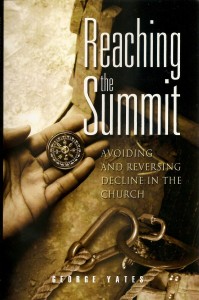
Portions of this article are excerpted from the introduction of Reaching the Summit: Avoiding and Reversing Decline in the Church. Visit here for more details and information.

Reaching the Summit

To order a copy send a check or money order for $14 plus $2 shipping and handling to the address at end of this article. For more information on “Reaching the Summit: Avoiding & Reversing Decline in the Church” click the link to soncare.net below.
Straight-forward, honest, practical! This book is a down-to-earth analysis of why so many churches are in decline – and what to do about it. Books like this, written by practitioners who have actually lead churches to healthy growth are far more significant than treatises by armchair experts who only criticize the church. If you are in a declining church, read this book and put its insights into practice. God wants your church to thrive and tools like this will facilitate that process.” Dr. Jeff Iorg, President, Golden Gate Baptist Theological Seminary

Practical, relevant, helpful, spiritually insightful, and encouraging are all words that describe this book.  Pastors of declining churches are often so discouraged that they experience ministry paralysis.  The paralysis only feeds into the decline of their church and more often than not persuades them that leaving is the only solution.  George Yates presents a case that will encourage the pastor to stick around long enough to personally lead the church out of decline.  Both pastor and church benefit from the lessons learned.  The principles and prescriptions found in this book will give hope and practical instruction to every pastor.  Rather than offering a list of possible changes, you’ll find instruction on honestly evaluating the situation as well as preparing a strategic solution to your own specific situation.”
Dr. Michael Landry, Senior Pastor, Sarasota Baptist Church, Sarasota, FL

“Is your church truly healthy or would an honest assessment reveal otherwise? Many pastors and leaders, believing their church to be healthy, should read this book as a guide for honestly assessing current reality. George Yates, the author, clearly and practically identifies the phases of church decline and presents them in such fashion that they can be used as evaluation inquiries for church leaders. George also offers clear strategies for addressing critical issues that contribute to church decline based on his years of experience serving and assisting churches coupled with his studies in church health. The readers will be challenged to examine their church in light of the Biblical mandate of reaching the lost and making disciples.” Larry W. Fillingim, Director of Missions, Noonday Baptist Association, Marietta, GA

“This book is dangerous in the hands of a ministry leader who believes that the church can be more than a weekly religious event. It describes the symptoms of the ailing church and gives sound ministry counsel as to finding the cure. The risk is in revealing the honest congregational answer to the question Jesus posed long ago, “Do you want to get well?” I have personally observed George wisely coaching churches to confront their realities and move toward their dreams. The church has never had a better friend.” Dr. Michael Stewart, Director of Missions, Central Coast Baptist Association

“Reversing Decline in the Church hits on all pistons. George has given us rock-solid understanding and action plans that flow from his life-long journey into God’s Word, his years in local church ministry and consulting churches, and his passion for Christ’s bride. Even if your church isn’t in decline, you’ll want to read this book. It will keep you from arriving there.” Rick Howerton, Small Group Specialist, NAV Press

“George Yates who taught us how to practice teaching that would bear fruit has now given us a book that will help turn the declining church around. With 80% of evangelical churches plateaued or declining this is a much needed work.” Dr. Ken Hemphill, Director of Center for Church Planting and Revitalization, North Greenville University

Address: SonC.A.R.E. Ministries, 2270 Bardstown Rd., Springfield, KY 40069

For more information or to order your copy visit: http://soncare.net

No Problems, Only Opportunities

Don was a member of one church where I served on staff. He truly had a servant’s heart. Don had retired from a local factory and spent much of his time serving God leading Bible studies and services in nursing homes, visiting shut-ins, and the sick in the community. I cannot remember a time when Don was not available and ready to serve in whatever capacity was needed; whether it was visiting, a demolition or refurbishing project, or driving someone to the airport or doctors appointment. Don truly was a servant of God and it humbles me still today when I think of his selfless, faithful service to our Lord.

I begin this article with my perspective of Don Hollingsworth because he taught me a lot and when God called me away from that church, I feel Don gave me one the greatest compliments I have ever received. On our last day of service with this particular church Don stood before the congregation and said, “One thing I learned from George is there are no problems in life, only opportunities.” Don went on to explain what that meant in general and in his personal life.

That may not seem like what you would consider a great compliment. I was not expecting this comment, still I consider it a compliment and a testimony of living day in and day out of how iron sharpens iron. Here was a man twenty plus years my senior, whom God was using to influence and encourage me and sometimes to humble me as well. Following his statement I began reflecting on our four years together in ministry and could recall Don entering my office, riding in the car to a visit, or even sitting at lunch. Though I may not have realized the events when they happened, I could now recall Don entering my office and saying we have a problem, or sitting at lunch, or in the car saying something similar using the word problem. My response was always the same, “Don, we don’t have a problem, we have an opportunity.” Then we would begin to explore the opportunity. What did God have in mind and in store for us through this opportunity?

You may ask what is the difference. The difference, I believe is huge and of cataclysmic proportion. When we look at issues and situations as problems, our efforts and outlook are only focused on the negative. No matter how we try to explain away our attitudes and actions dealing with problems always originate from the negative plane. You cannot put enough spin on your words or actions to remove it from the negative.

On the other hand when you deal only in opportunities you always deal from the positive plane. Where ever there is an opportunity there is the prospect of betterment. When we deal with opportunity our thoughts are on improvement or becoming better. I believe it is nearly (if not always) impossible to view opportunity from a negative plane. Opportunity imparts a positive point of view and positions you for a constructive approach to your situation or issue.

When we view our situation as a problem we almost always push the reasoning to someone or some event outside of our control. “It was the economy.” “Our people are not doing their job.” This is human nature because we cannot possibly view ourselves as the problem.
However, when we deal with opportunities we always probe how we can improve our organization, ourselves, and the productivity of our employees or volunteers. Dealing with opportunities in this manner becomes a winning situation for everyone.

Even in personal life those who deal in problems will always operate out of the negative plane. “I really messed that up. I don’t know what I am doing.” That is certainly dealing from a negative, problematic point of view. There was certainly something gone wrong here. I did mess up, the opportunity is, now how can I learn from this and take action steps to improve and demonstrate that I can do this and greater things than this.

Hopefully, by now you can see this is much more than semantics or a play on words. There is an enormous difference in attitude and action toward the issue, the people involved and the desired improved outcome.

In life you are given opportunities to help yourself and others. As long as you view people or situations as problems you will never rise above a negative perspective on life. And you will never be all that God created you to be. However, once you begin to view life as a series of opportunities, not only will your life improve. You will assist in the improvement of life for many. That my friends is the purpose God has for you in life.

Remember, there are no problems in life, only opportunities. Let’s improve something today!

Sunday School and Worship

I recently attended a worship service at a church I had not attended for a little over a year. Due to my morning schedule, I arrived late. It turns out the church had changed its service time from 11:00 to 10:30, so I was later than I thought. I had missed the music, offering, and apparently the first part of the pastor’s message. When I arrived a young man was standing in front of the congregation giving a testimony.

This man’s testimony was of time spent in prison and the rough, streetwise, vengeful life he had given up since entering into a personal relationship with Christ. According to his testimony, he has been living a life for Christ for several years and has claimed victory over past lifestyles and attitudes. It was a very good, compelling testimony. It just made you want to go up to him, shake his hand (or hug him) and hear more from him. Indeed after the service many people crowded around this young man to speak to him though he had been in the church for some time.

After this man’s testimony the pastor stood up walked to the center aisle (did not go to the platform or the pulpit) and addressed the congregation. I noticed he did not have a Bible in hand. Instead he had a Sunday School Leaders Guide, opened to a particular lesson. After commenting on the testimony and thanking the gentleman for sharing, the pastor told where he was reading from. It was obvious he was teaching the Sunday School lesson, and many in the congregation had Sunday School quarterlies and were following along.

At first I was a little surprised, thinking this pastor was using someone else’s script as his message – a Sunday School lesson. However, it did not take long to realize what he was doing. This is a pastor who knows and understands some of the dynamics of small group Bible study, otherwise know as Sunday School. Small groups are relational, built on growing relationships that encourage us to share and learn.

The Sunday School lesson being covered that day was about Joseph (Genesis 40) and his years of imprisonment. The pastor had recruited the young man to give his testimony that particular day because it related to the message. The pastor related like Joseph we need to live a life worthy of the name “Christian” no matter what life circumstances we find ourselves in.

The pastor spoke to the congregation of the importance and their need to be in Sunday School. He gave the times for Sunday School and encouraged everyone to be part of Sunday School. He spoke to various age groups and social groups in the congregation and shared features and benefits for them of being in Sunday School. He preached Sunday School.

Those who know me know I am whole-heartedly, 100% pro-Sunday School (small open group Bible study). It is the one common denominator around the world that produces sustained “church” growth.

I left that church feeling good about what I had witnessed. God spoke to me and encouraged me through the service that day. I asked the pastor permission to write about my experience that day. I pray that more pastors would take his example. It is not about the next great program, gimmick, or fad. It is following Jesus’ example; share with the multitudes, influence as many as you can, and teach a small group how to live and how to pass it on in their daily lives. This is Teaching That Bears Fruit.