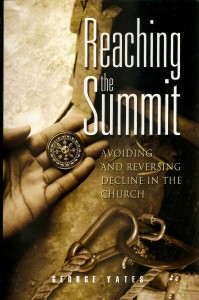
As I visit churches and Sunday School classes or small group Bible study classes, I am often dismayed at the number of knowledge and information dispensers we have leading our classes. Knowledge is good, and biblical knowledge is wonderful and great to acquire. However, if biblical knowledge is all we are teaching in our classes it is my opinion that we are missing God’s plan and purpose for our teaching.
In a recent conversation with an Minister of Education, I noted that some of his teachers (information dispensers) are teaching the only way they know. In some cases it is the only way he/she has ever seen demonstrated. In many situations it is the easiest, most comfortable to the teacher and it seems reasonable to pass on what I read and understand from scripture.
Teachers (and preachers) spend several hours each week studying and preparing for the lesson to be delivered on Sunday (or their particular meeting time). We study reading scripture, gleaning from our 27 commentaries and the thousands of resources available on the internet. Teachers are to be commended for their time spent in study and preparation. The reward is theirs for studying and learning more about God and His plan. The problem comes at the end of our preparation when we walk into the classroom carrying with us all the information we have been able to glean in 3, 5, 7, or even 10 hours of study, and we set out to expend all of our newly acquired knowledge on those sitting in front of us – in 30 minutes.
In Teaching That Bears Fruit, I call this the Dump Truck method of teaching. We spend all week loading our dumptruck up, back it into the classroom on Sunday morning and dump the whole load on our listeners. The drawback is it is unusable to our listeners, unless we are attempting to build Bible trivia buffs. Information dispensed in this manner can become an obstruction rather than an aid in living the Christian life.
An experienced dump truck driver carrying a load of gravel knows how to raise the dump bed gradually as he drives along unloading the gravel in a smooth and immediately usable manner. The first time I attempted to unload a truck full of finely ground limestone, it all came out in one pile. Needless to say it was not usable. It took an entire crew of workers with shovels and rakes to come behind me and smooth out limestone so it could be used. I was not the MVP on the job that day.
In Bible study, we do not have the luxury of having a crew come in behind us and work our information dump into a usable road for our listeners to travel. It’s time to put a for sale sign in the dump truck and begin teaching the way jesus taught. If we want our listeners to become life changing learners, we must teach for life change. We must move from being knowledge dispensers to agents of life-change, and initiators of learning experiences for our listeners. This is teaching the way Jesus taught. This is teaching that bears fruit.
For more information about Teaching That Bears Fruit visit http://soncare.net
As Goes California, so Goes the Nation
The following first appeared in an earlier blog post on June 20, 2009.
Seven years ago I was asked to go on a mission trip to California. David Suddath, Jeff McGukin and I spent six days speaking and consulting with 14 churches in the central coast region of CA. God burdened my heart for the churches of that region and ten months later my wife, Pam, and I moved to CA and served on staff with Central Coast Baptist Association for six plus years.
While on that mission trip two of the churches I spoke with told us, “We wish we knew what you are telling us 30 years ago.” Both of these churches had less than 15 people attending. The youngest person in one of these churches was 58. Everyone else was above 72 years of age. Once vibrant churches running as many as 300, they still had the desire to see their churches grow for God, but they no longer had the strength or manpower. One of these two churches has since closed and the other one runs about 11 people on Sunday morning.
Unfortunately, this scenario plays out over and over again throughout central and northern CA. Especially in the “Anglo” (English speaking, mainly Caucasian) congregations. More than 60% of all Anglo congregations in the San Francisco bay area and the Silicon Valley have less than 45 in worship attendance on Sunday mornings. Most of these are running less than 30 and shrinking annually.
Churches can make the turn-around and some of these in CA are doing just that. They have made the turn and are growing. For most it is a long and painstaking effort. But, if you’re in it for the right reasons, it is well worth the effort. I know of a couple of those churches now running more than 100 on Sunday mornings and one that has grown from 3 to sixty plus in attendance in less than 3 years. Others have worked through a strategy planning phase and now entering the implementation phase, beginning to see results.
I write and speak about this because I have served in and consulted with churches in the south and midwest most of my life. After moving to CA, I realized what I saw in churches there was on its way to the South and midwest, churches all across the nation. Churches across the U.S. sitting comfortably with 125-250 members today, will be those churches that we spoke to on the mission trip and those that I worked with in central CA.
I have commented to several church and denominational leaders over the past four years stating, those churches of 125-250 today will be the churches of 15-25 in ten to fifteen years. If an awareness of urgency is not prompted today, those will be the churches closing their doors and dissolving in 2020. They will be the churches saying, “If we had only known in 2010 what you are telling us today…”
It did not surprise me when outgoing president of the Southern Baptist Convention, Frank Page, in May of 2008 stated, “Unless something is done to reverse the downward trend, Southern Baptist churches could number only 20,000 — down from the current total of more than 44,000 — in fewer than 22 years.” Published May 6, 2008 ABP. Page made a statement that many pastors, church and denomination leaders are afraid to make. Yet, statistics and factual information continue to reveal this is truth. Recent reports and research is showing similar trends in nearly all evangelical church denominational lines.
As church leaders we must take heed of the warnings and the signs of the times surrounding us. Not only take heed, we must sound the trumpet and become intentional about reversing the trend in our churches. We have been told for several years that 80% or more of our churches are plateaued or declining. My friends, a plateaued church is a dying church, just as is a declining one.
I am thankful for God’s servants such as Frank Page, Ed Stetzer, George Bullard, Bob Logan, Josh Hunt, Beth Moore and many others who are working to give us needed information and tools to assist in turning around the church of God’s kingdom and reversing the trends we have allowed in our churches today. I am equally grateful for the practitioners leading the way in needed change in our churches.
Along life’s journey I have made my mistakes, and I will make more. But, when I stand before the Lord, I want to hear the words, “Well done fruitful and faithful servant.” I desire to be a fruitful and faithful servant for my Lord. If I can do this by helping you and your church, then I am one step closer to fulfilling my Calling.
Visit http://soncare.net for equipping articles and resources for a healthier church.